
By Tradecraft
Why the Phones Still Sound Like a Phone Tree
Shop software owns the board and rents the phones. How to tell an AI receptionist from a phone tree that writes the job your tech opens after hours.
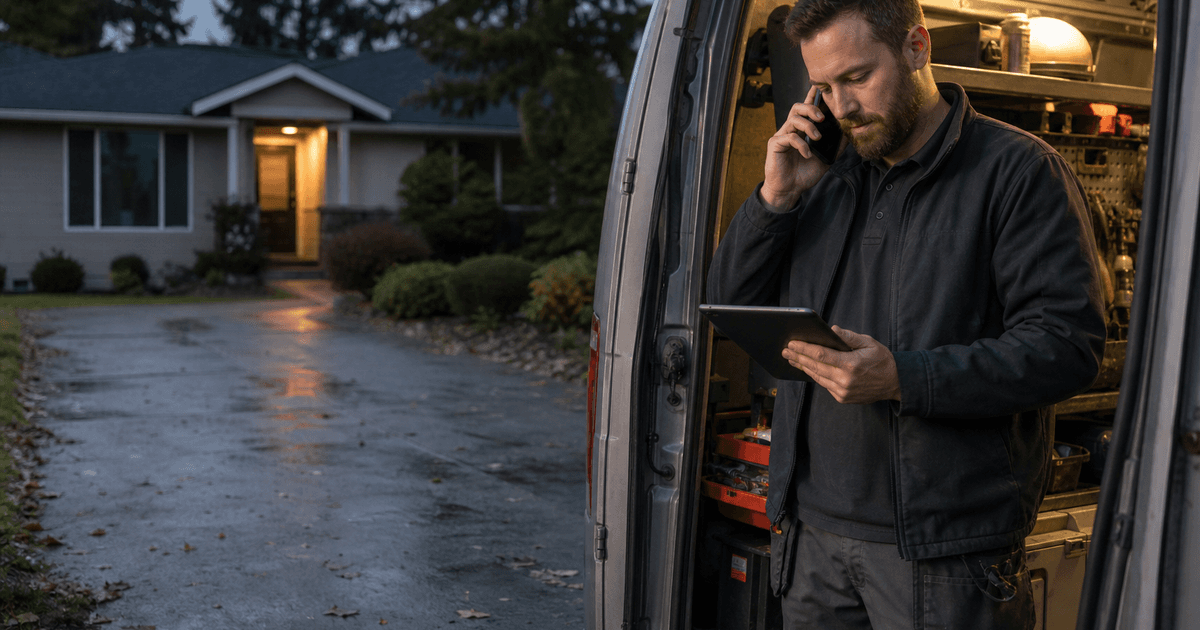
The vendor demo is a quiet headset.
Your customer is in a driveway with a truck idling and a kid yelling in the back seat. They cut the agent off mid-sentence: Saturday, not Friday, and the side gate is locked.
Does the voice stop? Does it hear the correction? Does the board your tech opens at 7 a.m. still match?
That is the real test. Not whether the demo voice sounds friendly for thirty seconds. Not whether the software company put "native AI" on a slide. The test is whether a messy call becomes the right job without making the office clean it up tomorrow.
This week you can run the same noisy-cell-phone test on every vendor. Tomorrow morning you can open the job and see whether Saturday and the side gate survived. If the board already works, you can keep it and still demand a better call.
If you are comparing the wider field-service market, start with the Tradecraft alternatives hub. This guide stays on a narrower question: why the phones still feel like a phone tree even when the job lands on a modern board.
"Native" to the board is not the same as natural on the phone
Field-service software can know your customers, services, schedule, and tech availability. That matters. It can make the booking native to the board.
But the call has another job before any record gets written:
- Hear a customer through cell noise.
- Know when they are finished speaking.
- Stop immediately when they talk over the agent.
- Keep the correction instead of the first answer.
- Finish the booking without stacking dead air and repeated questions.
Those are phone problems, not scheduling problems.
That distinction explains why a tool can be good at field service and still sound like a robot on a real call. The company may own the job board while another platform handles some or all of the conversation loop. Public product pages rarely explain that audio path.
Ask a direct question in the demo: Who controls the call from the first word through the booked job?
If the answer is only "it integrates with our calendar," you learned about the board. You did not learn about the phones.
Why the pause feels worse than the voice
Owners often blame the voice itself. Sometimes the bigger problem is the silence between turns.
A common phone stack works like this:
caller audio -> transcript -> language model -> generated speech -> phone
Each handoff adds time. The system also has to decide when the caller stopped talking. Wait too long and the line feels dead. Decide too fast and it cuts off an address, model number, or correction.
Jobber's own Receptionist help documentation recommends simulated background noise during processing pauses so clients know the call is still active. That is an honest product choice. It also tells you something useful: a pleasant sample voice does not remove the pause.
On a quiet headset, a pause can feel acceptable. On a no-heat call with weak cell service, it feels like the line dropped.
Speech-to-speech takes a shorter path. One model hears the audio and speaks audio, while the call runtime controls turn-taking, tool work, and cancellation. It does not guarantee a good call by itself. It removes handoffs that make a call feel stitched together.
Tradecraft uses a speech model to hear and speak, and a carrier phone network to reach the line. Those are the engines. The superpower is the runtime Tradecraft owns: it stops when the caller talks, keeps the correction, and writes the same board the office and truck open.
The AI receptionist test is a messy correction
The caller says Friday.
The agent begins checking Friday.
The caller jumps in: "Actually, Saturday. After two. And use the side gate."
A phone tree keeps reading. A brittle bot stops but loses the first half of the correction. A better call does three things:
- Stops the old speech.
- Cancels or corrects work already in flight.
- Confirms the final day, time, and access note before writing the job.
This is why "Can callers interrupt?" is too easy a demo question. Most vendors can make the voice stop in a controlled test.
Ask instead:
Can I change the day while it is checking the schedule, and will the final job still be right?
That tests the phones and the board at the same time.
A form with a voice is still a form
Home-service intake has fields: name, phone, address, service, urgency, preferred window, access notes.
The bad version reads those fields in order no matter what the caller already said. The homeowner gives the address in the first sentence. Three questions later, the bot asks for the address again.
Jobber's help docs say Receptionist uses the selected request form to submit requests, and uses Online Booking settings when it books into the calendar. That is useful when the form matches the call. It is a problem when the caller already answered a field the form still wants to ask. In a Jobber community thread, one owner said they loved Receptionist even though it was not quite what they needed yet.
Trade callers still ask licensed questions a form never covered: R-22 systems, 400-amp service, furnace replacement price. Treat those as the calls that break a script, not as a survey.
No phone agent should pretend to diagnose licensed work or promise a price it cannot support. But it should know the difference between:
- A question it can answer from the shop's service catalog.
- A question that needs a qualified human.
- An emergency that should wake the on-call tech.
- A standard request that can be booked now.
"Someone will call you back" is a safe answer. If every valuable call ends there, you bought better voicemail.
The morning-after test
Do not evaluate the phone in isolation. Open the job the next morning.
Check:
- Correct customer and callback number.
- Correct service address.
- Final day and time, not the first one mentioned.
- Service type and urgency.
- Side gate, pet, parking, or access note.
- The same record in the office and on the tech's phone.
- A clean handoff if the caller asked for a person.
The useful question is not "Did the bot complete the call?"
It is "Can dispatch run this job without replaying the recording?"
That is where phone-only AI and a full operating system separate. A transcript can be accurate and still leave the office typing. A booking can exist and still be missing the detail that sends the tech to the wrong door.
For the broader distinction between agents that only capture work and agents that help run the whole day, see AI Agents in the Trades.
Run this five-minute bake-off before you buy
Call every product from the same cell phone. Do not use the vendor's browser demo.
Put a fan, truck, or radio in the background. Then use this script:
- "My furnace stopped working and I need someone Friday."
- While it checks, say: "Wait, Saturday after two works better."
- Give the street number once, then spell the street name.
- Add: "The front gate sticks. Use the side gate."
- Ask one shop-specific question.
- Ask for a human, then decide you want to finish booking instead.
Score the result:
| Check | Pass | Fail |
|---|---|---|
| First sound | A useful reply with no fake dead air | Long silence, or a hold tone that hides processing |
| Talk-over | Stops the old sentence | Finishes the Friday pitch |
| Correction | Saturday is the only time on the job | Friday is still on the record |
| Job record | Dispatch opens the same job | The office types from a transcript |
| Truck view | The tech sees the side gate | The access note is missing |
| Handoff | A human has the story | The caller repeats everything |
This is a test method, not a published bake-off with vendor scores. Run it yourself. Do not buy a ranking from a slide.
Tradecraft's published target is about half a second to the first voice response. Treat that as a product claim to test, not a stopwatch guarantee. Cell networks, phone routing, and the caller's environment matter. If you want that test on Tradecraft, book a demo and run it from your cell phone.
When keeping your current board is the right choice
The answer is not always "replace everything."
Jobber can be the right board for a smaller shop that values straightforward quoting, scheduling, and client work. Jobber's help docs say Receptionist can create requests and book jobs in the Jobber calendar when those settings are enabled. If that workflow fits, test the real phone experience and keep the simpler stack.
Housecall Pro is a strong fit when your team already runs scheduling, payments, and customer history there. Housecall Pro publishes CSR AI as built into the account, using existing services and availability to book, with escalation rules you configure. Ask how messy trade questions get handled, and whether the tech sees the same notes.
ServiceTitan still fits large and multi-location shops that need deep modules, contact-center operations, and enterprise controls. ServiceTitan publishes an AI Virtual Agent that can use live board data and transfer a call to a live CSR when the request sits outside its rules. That is meaningful native depth. It does not tell you who controls every millisecond of the audio path, so test that separately.
If the board is staying and the phones are the only wound, compare dedicated phone layers such as Broccoli AI and Avoca AI. They are easier to justify than a full migration when your FSM already works.
That is also the Service Socket path: keep the board you like and add a trades-focused front office.
For the full pricing and product comparison, use Tradecraft vs ServiceTitan, Jobber, and Housecall Pro. This article is about the call, not another seat-price grid.
When the phones and the board should be one system
Tradecraft is for the shop that does not want another layer beside the FSM.
The call runtime and the job board are part of the same product. The agent can hear, book, transfer, and leave the final details on the record the office and field team already use. Voice, chat, dispatch suggestions, quotes, invoices, payments, documents, inventory, training, and marketing do not need separate customer stories.
Published monthly pricing:
- Shop: $199/month with 3 admin seats, unlimited technicians, and 1,000 AI credits.
- Business: $399/month with 10 admin seats, unlimited technicians, and 5,000 AI credits.
- Metered credit overage starts only after the included pool.
- Enterprise is custom.
Check the current Tradecraft pricing page before deciding. Plans and competitor offers change.
The point is not that every shop should migrate. The point is that "native AI" should mean more than a booking appears somewhere. The phones should survive the messy call, and the board should preserve the final answer.
FAQ
Why does an AI phone system sound robotic?
Often because it waits for speech to be transcribed, processed, and generated before replying. That creates dead air and awkward turn-taking even when the voice sample sounds polished. Network noise and poor interruption handling make it worse.
Why does the bot talk over customers?
The system may still have generated speech buffered after the customer starts talking. A good call runtime stops the old audio, keeps the new words, and corrects any booking work already in progress.
Is a phone tree the same as an AI receptionist?
No. A traditional phone tree routes callers through menus. A modern agent should understand normal speech and take action. But an agent that follows a rigid form, repeats questions, or cannot accept corrections can still feel like a phone tree.
Can AI handle after-hours HVAC and plumbing calls?
Yes, for structured intake, booking, service-area checks, notifications, and escalation rules. A safe system should hand licensed diagnosis, uncertain emergencies, pricing exceptions, and distressed callers to a person.
Does the call need to write directly to the dispatch board?
If dispatch has to replay a recording or retype a summary, the automation stopped too early. The final customer, address, time, service, urgency, and access notes should be on the same job the office and tech open.
Should I replace Jobber, Housecall Pro, or ServiceTitan for better phones?
Not if the board already works for your shop. Add or test a phone layer first. Replace the system only when the extra tools, duplicate records, and manual cleanup cost more than a migration.
What should I test in an AI phone demo?
Use a real cell phone with background noise. Change the booking day while the agent checks availability. Add an access note. Ask for a person. Then inspect the job your dispatcher and tech received.
How fast should an AI receptionist answer?
There is no universal stopwatch. If the line feels dead, callers talk over the agent or hang up. Tradecraft publishes a target of about half a second to first voice. Test that on a real cell phone. Do not buy a number from a slide.
Close
A friendly voice is not the finish line.
The phone has to stop when the customer talks, keep the correction, write the right job, and leave dispatch with nothing to clean up.
Compare field-service and AI options on the Tradecraft alternatives page, verify published pricing, or book a demo and run the noisy-cell-phone test yourself.
Request a demo
Run the noisy-cell-phone test on Tradecraft. Bring the Friday-to-Saturday correction and see the job your tech would open.
Request a demo