
By Tradecraft
How to Price a Plumbing Job: Labor Rate, Overhead, and Markup
A worked example from a $30/hr wage to a profitable flat-rate task price: labor burden, billable hours, overhead per hour, markup vs margin, and when flat rate beats hourly.
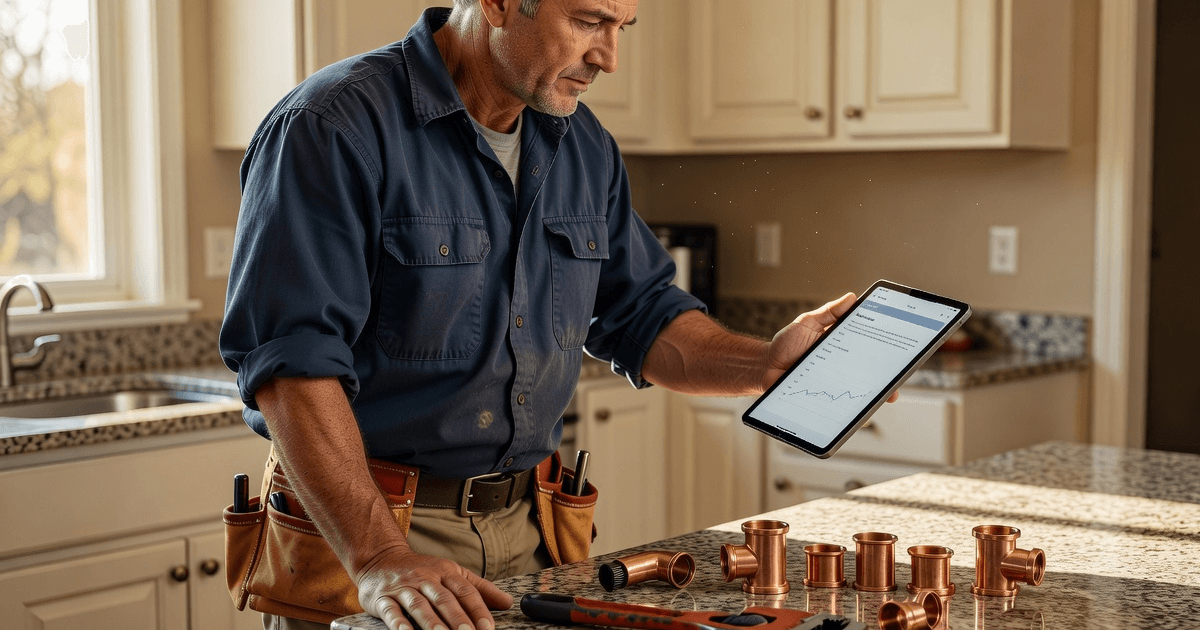
A $30-an-hour plumber does not cost you $30 an hour. That is the whole problem, and it is why so many shops work flat out and still have a thin bank account at the end of the quarter.
Pricing a plumbing job correctly means working through four numbers in order: the loaded labor rate, your real billable hours, overhead per billable hour, and then the margin you actually need. This guide walks the math end to end with an example you can copy onto a spreadsheet, then shows when a flat-rate pricebook beats hourly billing - and how the software handles it.
TL;DR
- Your technician's wage is not your labor cost. Payroll taxes, workers comp, benefits, and unbillable time roughly double it.
- Overhead (trucks, insurance, software, office) has to be divided across billable hours, not paid hours.
- Breakeven hourly rate = loaded labor per billable hour + overhead per billable hour. Price above it, not near it.
- Markup is on cost; margin is on price. A 50% markup is only a 33% margin. Confusing them is how jobs get sold at a loss.
- Flat rate wins on repeatable scope; hourly (or time and materials) wins on unknown scope.
- A pricebook turns the math into a catalog your techs can sell from on site.
Step 1: The loaded labor rate
Start with what the hour actually costs you, not what the paycheck says.
Take a journeyman at $30/hr. On top of the wage, you carry the employer's share of payroll taxes (7.65% FICA), workers compensation (commonly a high single-digit to low-teens percentage for plumbing, depending on state and class code), health insurance and benefits, PTO and holidays, plus small items like uniforms, tools, and training. A realistic burden lands around 30-40%.
| Line | Example |
|---|---|
| Base wage | $30.00/hr |
| Payroll taxes (FICA, ~7.65%) | $2.30/hr |
| Workers comp (~10%) | $3.00/hr |
| Benefits + PTO (~12%) | $3.60/hr |
| Tools, uniforms, training (~5%) | $1.50/hr |
| Loaded wage | $40.40/hr |
That is already $40.40 before anyone drives anywhere. But the plumber is not billing every paid hour - and that is where most shops undercount.
Step 2: Billable hours, not paid hours
A full-time tech is paid for about 2,080 hours a year. How many of those hours can you actually invoice? Subtract PTO and holidays, drive time between calls, callbacks and warranty work, shop time, training, and the slow Tuesday in February.
Realistic billable efficiency for a service plumber runs roughly 55-65%. Call it 1,200 billable hours a year.
| Line | Example |
|---|---|
| Paid hours per year | 2,080 |
| Billable hours per year (~58%) | 1,200 |
| Loaded annual labor cost ($40.40 x 2,080) | $84,032 |
| Loaded cost per billable hour | ~$70/hr |
Your $30/hr plumber now costs you $70 every hour you can actually bill.
Step 3: Overhead per billable hour
Now add everything else that has to be paid whether or not a single job books: truck payment, fuel, and commercial auto insurance; general liability; office rent or your share of it; office staff; software subscriptions; phones; marketing. This is your overhead pool.
Say it totals $80,000 per tech-year (yours will differ - pull it from your P&L, not from this article):
| Line | Example |
|---|---|
| Loaded labor per billable hour | ~$70 |
| Overhead per billable hour ($80,000 / 1,200) | ~$67 |
| Breakeven hourly rate | ~$137 |
Below $137/hr you are paying the customer to hire you. This is the number most shops have never computed.
Step 4: Add margin, not vibes
Breakeven keeps the lights on. Margin pays for the slow month, the bad debt, the growth hire. Say you target a 20% net margin:
Price = breakeven / (1 - margin) = $137 / 0.80 = ~$171/hr billing rate.
Round to your market. $165-$185/hr is a defensible number in a lot of metros once the math is honest. If your current rate is below your breakeven, no amount of "more leads" fixes that - you just lose money faster.
Markup vs margin (the table worth bookmarking)
Owners say "I marked it up 50%" and mean a 50% profit. They got 33%. This table is the correction:
| Markup on cost | Equals margin on price |
|---|---|
| 25% | 20% |
| 33% | 25% |
| 50% | 33% |
| 67% | 40% |
| 100% | 50% |
The rule: margin = markup / (1 + markup). If you need a 40% margin, you mark up 67%. Apply this to materials the same way - a $900 water heater at 30% markup bills at $1,170 and earns a 23% margin on materials.
Step 5: From hourly rate to a flat-rate task price
Once you know your billing rate, flat-rate pricing is just multiplication. Water heater install: 4 billable hours x $171 = $684 labor + $1,170 materials = roughly $1,850 all-in. Drain clear: 1.5 hours x $171 + minor parts = ~$300. Rebuild the whole task list once and you have a pricebook.
Flat rate wins when scope is repeatable: water heaters, fixture swaps, drain clears, disposals. The customer hears one number before you start, your tech sells from a book instead of improvising, and a fast tech stops being punished for efficiency.
Hourly (or time and materials) still wins when scope is genuinely unknown - diagnostics, mystery leaks, repipes hidden in walls. Charging flat rate on unknown scope is just gambling.
Good-Better-Best closes more of them
A single price is a yes/no question. Three options change the question to "which one." Good: repair or base model. Better: standard replacement with warranty. Best: premium unit, longer warranty, add-ons. Most customers pick the middle - which is exactly where your margin should be concentrated. This works on quotes whether your rate is flat or hourly.
Where the software fits (the pricebook section)
The math only pays if it lives where the tech sells - in a pricebook they pull up on site, not a binder back at the shop.
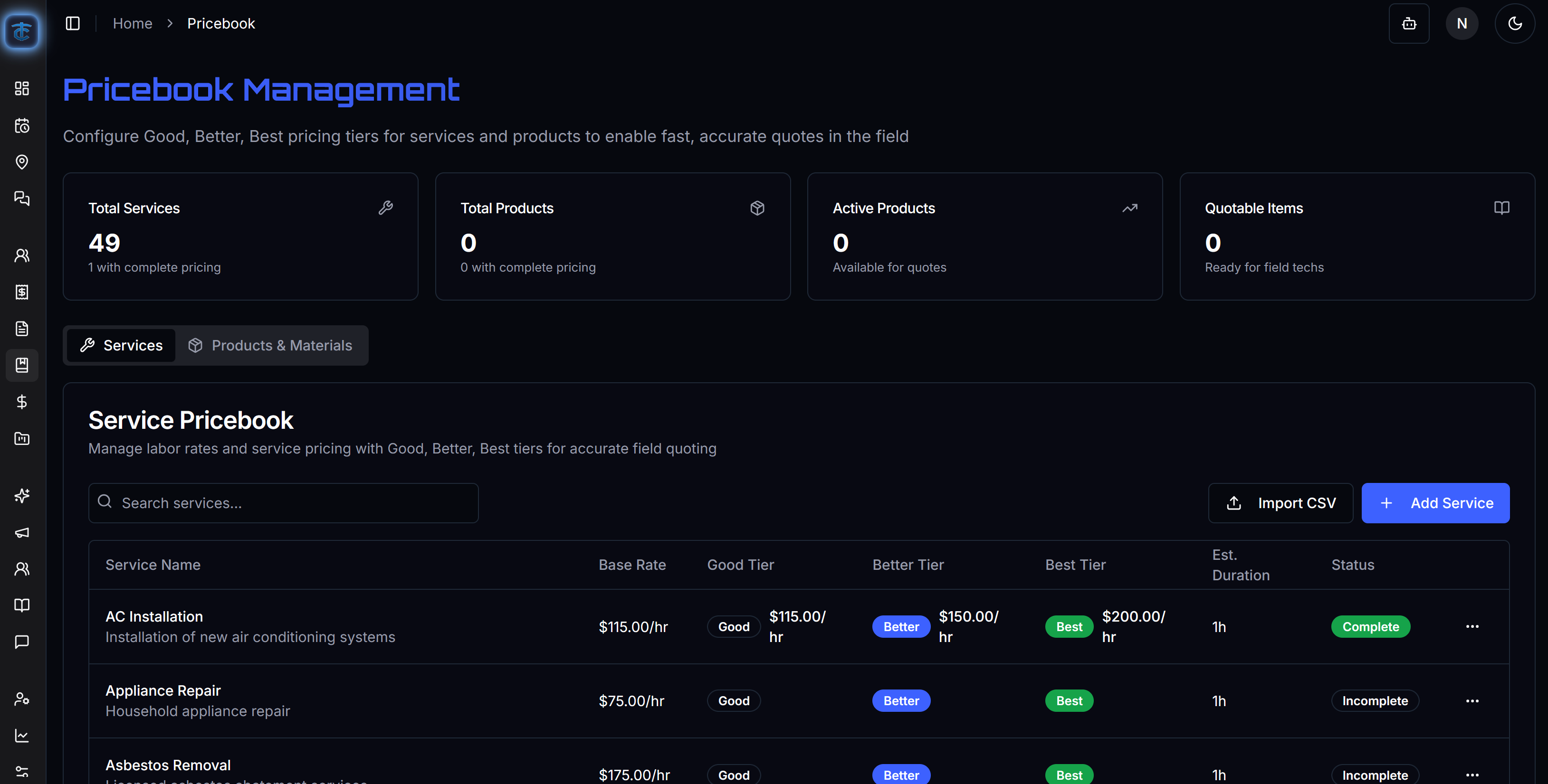
Here is how the common platforms handle flat-rate pricebooks, and where Tradecraft fits:
- ServiceTitan offers a managed pricebook (Pricebook Pro is commonly discussed as a paid module) with deep flat-rate catalogs - powerful, at enterprise pricing. ServiceTitan deep dive
- Service Fusion leans on flat-rate pricebook workflows with unlimited-user packaging. Service Fusion deep dive
- FieldEdge has a long flat-rate history in HVAC and plumbing. FieldEdge deep dive
- Housecall Pro includes a price book on its tiers aimed at residential trades. Housecall Pro deep dive
- Jobber covers quoting cleanly for SMB shops, lighter on flat-rate catalog depth. Jobber deep dive
More comparisons live on the Tradecraft alternatives hub.
How Tradecraft handles it
Tradecraft puts the pricebook next to the quote instead of in a separate tool: your task catalog with set prices, Good-Better-Best options on the quote, the accepted quote flowing straight into an invoice and Stripe payment, and QuickBooks or Xero keeping the books honest with the work you actually sold. No retyping the job into three systems.
The plumbing math stays yours - the platform just stops the re-entry. For the bigger picture on that loop, see from the first call to the paid invoice and where the day goes on the road.
Published pricing: Shop $199/mo or Business $399/mo, unlimited technicians, 1,000 / 5,000 AI credits included, metered overage only after the pool.
FAQ
What is a loaded labor rate? Your technician's true hourly cost: wage plus payroll taxes, workers comp, benefits, PTO, and similar burden - divided by the hours you can actually bill. A $30/hr wage commonly lands near $70 per billable hour.
Should plumbers charge flat rate or hourly? Flat rate for repeatable scope (water heaters, drain clears, fixture swaps) - customers prefer one number and techs sell from a book. Hourly or time-and-materials for unknown scope like diagnostics and hidden leaks.
What markup should a plumber use on materials? Enough to cover handling, warranty risk, and the margin you targeted - commonly 25-50%+ markup. Remember that a 50% markup is only a 33% margin.
How do I calculate overhead per billable hour? Total annual overhead (trucks, insurance, software, office, marketing) divided by annual billable hours per tech - not paid hours. Use your own P&L numbers.
Does field service software include a pricebook? Most FSM platforms include some pricebook capability - ServiceTitan, Service Fusion, FieldEdge, Housecall Pro, and Jobber all handle it differently in depth and pricing model. Tradecraft includes a pricebook that feeds Good-Better-Best quotes and invoices on one board.
Close
Price the labor you can actually bill, load the overhead honestly, add real margin - and then put the whole thing in a pricebook so the number is consistent from the first call to the paid invoice.
See how the software side compares on the alternatives page, check pricing, or book a demo and walk a real quote from pricebook to payment.
Request a demo
Run the noisy-cell-phone test on Tradecraft. Bring the Friday-to-Saturday correction and see the job your tech would open.
Request a demo